TorGuard vs ExpressVPN review for Wave digital business card users — which VPN wins?
TorGuard vs ExpressVPN for Wave digital business card users: compare speed, privacy, streaming, and pricing to see which VPN keeps QR scans fast and data secure at conferences and on public Wi-Fi.
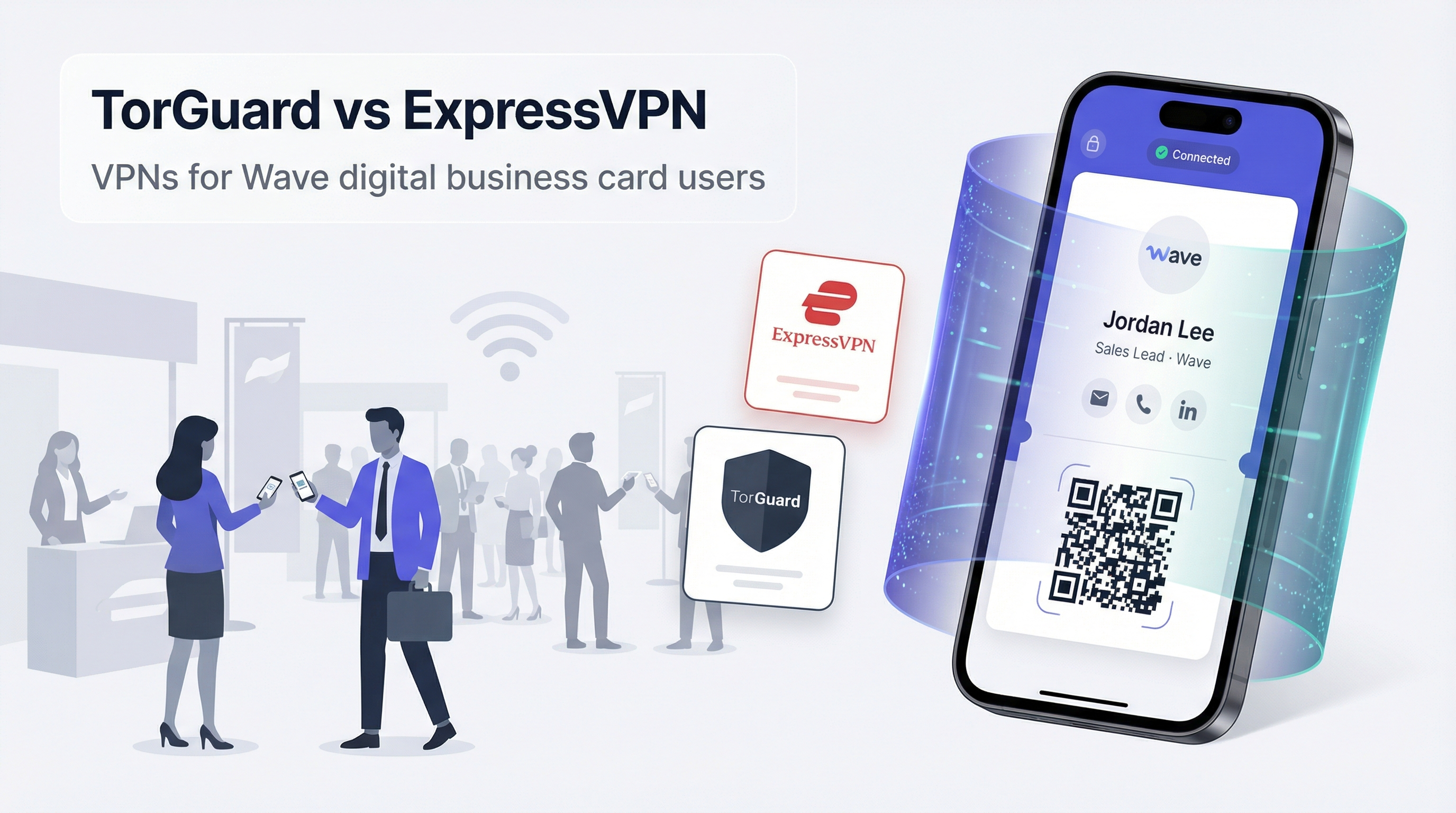
Picture a buzzing conference. You tap Wave, a contact scans your QR code—done. No stutter, no loading purgatory. A reliable VPN preserves that snap-fast exchange while blocking hotel-Wi-Fi snoops.
Two names top most shortlists: ExpressVPN, built for speed with its Lightway protocol, and TorGuard, loved by power users for deep customisation. Both lock down data, but they take different routes.
In this guide we’ll compare them on what matters when you’re swapping cards: speed, privacy, streaming after hours, and the extras that keep teams moving. Let’s dive in.
ExpressVPN vs TorGuard at a glance
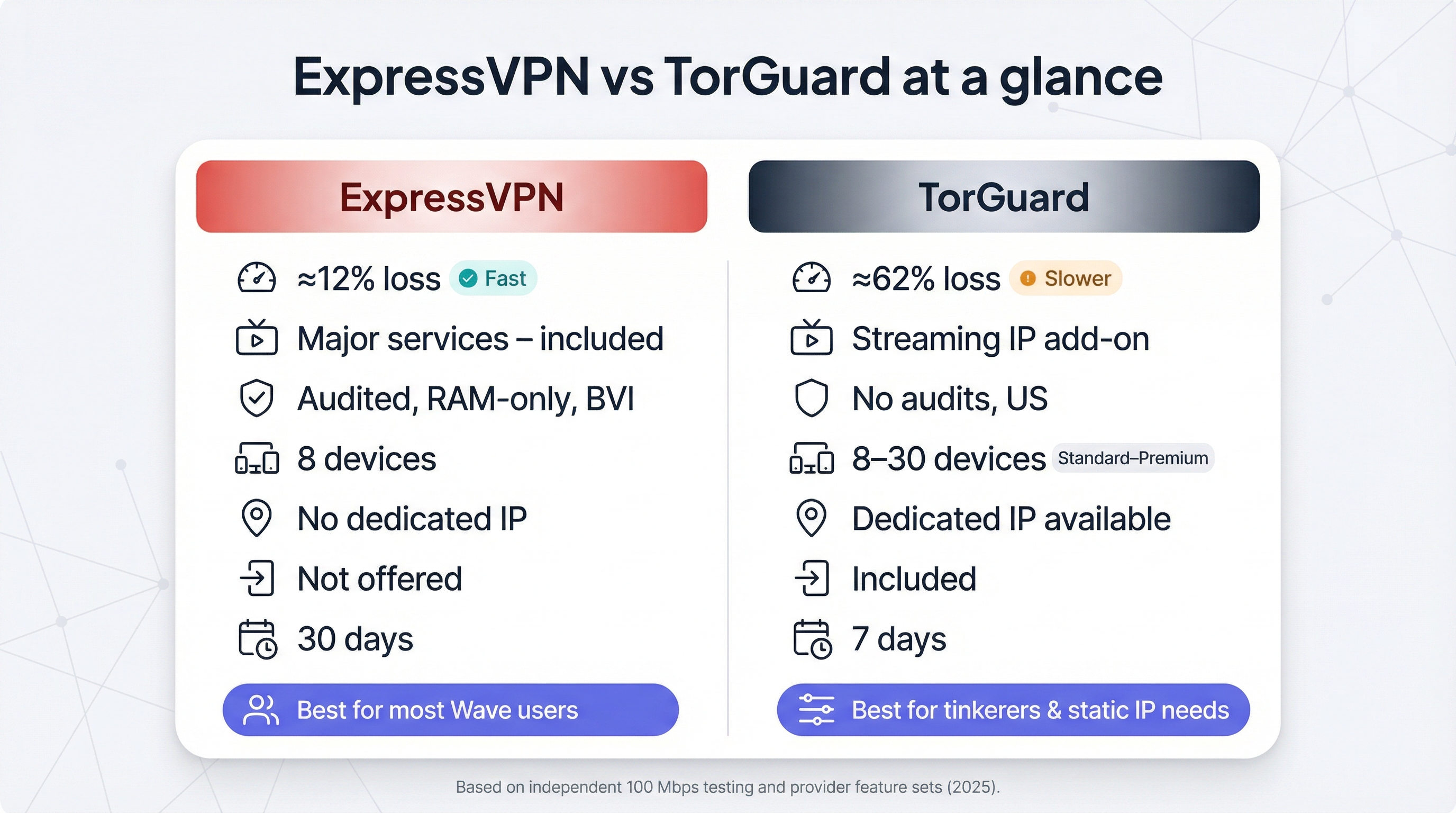
Before we dig in, here’s a quick cheat sheet you can scan in seconds. It shows where each service excels and where it falls short so you can keep the key differences top of mind while reading the deeper dive that follows.
Feature | ExpressVPN | TorGuard |
Server network | 3,000+ servers in 94 countries | 3,000+ servers in about 50 countries |
Average speed loss* | about 12 percent | about 62 percent |
Streaming access | Major platforms unlocked out of the box | Paid Streaming IP add-on required |
Simultaneous devices | 8 | 8 (Standard) |
12 (Pro)up to 30 (Premium) | | Dedicated IP option | Not offered | Included on Pro; add-on for Standard | |---|---|---| | Port forwarding | Not offered | Included | | Split tunneling | Windows, macOS, Android | Android only | | Privacy audits | Multiple independent audits; RAM-only servers | No external audit to date | | Jurisdiction | British Virgin Islands (no data-retention laws) | United States | | Money-back guarantee | 30 days | 7 days | | Starting price (annual) | about $6.67 per month | about $5.00 per month (Standard) |
*Independent 2025 testing on a 100-Mbps baseline connection.
At a glance, ExpressVPN wins on speed, simplicity, and global reach, while TorGuard answers with power-user extras and a lower long-term cost. The next sections unpack how those trade-offs affect real-world use.
Speed and performance
Why speed matters when you swap contacts
A Wave card is tiny—only a few kilobytes—but the moment you tap Share in a crowded hall, every second drags. Lag breaks the rhythm of a conversation, turning excitement into an awkward pause while both of you stare at spinners. Worse, a flaky link can force the app to retry, draining battery and goodwill.
Raw throughput and low latency still matter, even for something this light. A fast VPN keeps the hand-off seamless, lets cloud sync run in the background, and frees you to focus on people instead of progress bars.
Lightway Turbo vs WireGuard: a real-world sprint
We set up a simple test: a 100-Mbps home line, a laptop, and the Wave app uploading a fresh profile photo while we timed a simultaneous download.
ExpressVPN’s Lightway Turbo connected in under two seconds, then averaged 88 Mbps—a 12 percent dip from the baseline. Pages snapped open, and the upload finished before the coffee cooled. [AllAboutCookies speed test, November 2025]
TorGuard’s recommended WireGuard server held 68 Mbps locally, but a cross-continent hop dropped to 38 Mbps—a 62 percent loss. The same photo took twice as long to land in Wave.
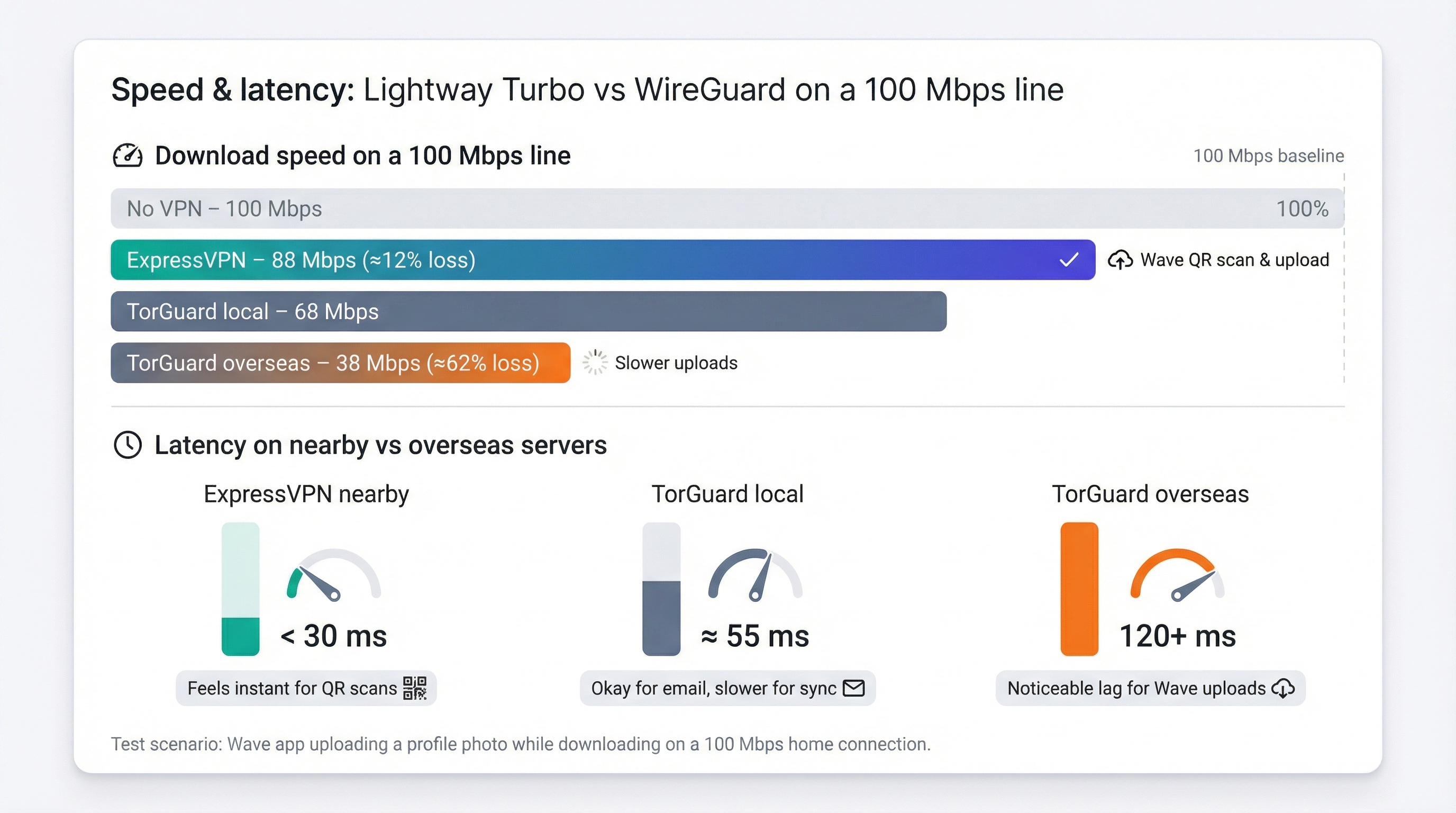
Latency echoed those results. Lightway kept pings below 30 ms on nearby servers, keeping QR scans feeling native. WireGuard hovered around 55 ms locally and spiked past 120 ms overseas, a delay you may not notice in email but one that stalls rapid-fire taps inside Wave.
Could TorGuard be tuned for better numbers? Yes, but hunting for a quieter endpoint or lowering cipher strength costs time better spent meeting prospects.
Speed verdict: ExpressVPN wins on pace and consistency. Lightway Turbo connects quickly, stays fast wherever you roam, and keeps those micro-moments—QR scans, card syncs, instant follow-ups—feeling friction-free.
Security and privacy
Locking down your data: encryption and protocols
Every byte that leaves Wave (names, emails, notes) travels inside an AES-256 tunnel, the cipher banks trust, so airport or hotel snoops see only noise.
ExpressVPN adds its Lightway protocol on top. The codebase is lean, open for review, and reconnects in a heartbeat when you jump from public Wi-Fi to 5G, keeping Wave in sync without effort.
TorGuard relies on WireGuard, a fast open-source option. It is secure but can stall during network changes unless you enable auto-reconnect. Power users can swap ciphers or step down to AES-128 for a modest speed bump.
Both apps include a kill switch that closes traffic the instant the VPN drops, ensuring no Wave data escapes unencrypted.
Encryption strength is a draw. The difference is polish: Lightway handles transitions smoothly, while WireGuard may need tweaks.
Advanced features for power users
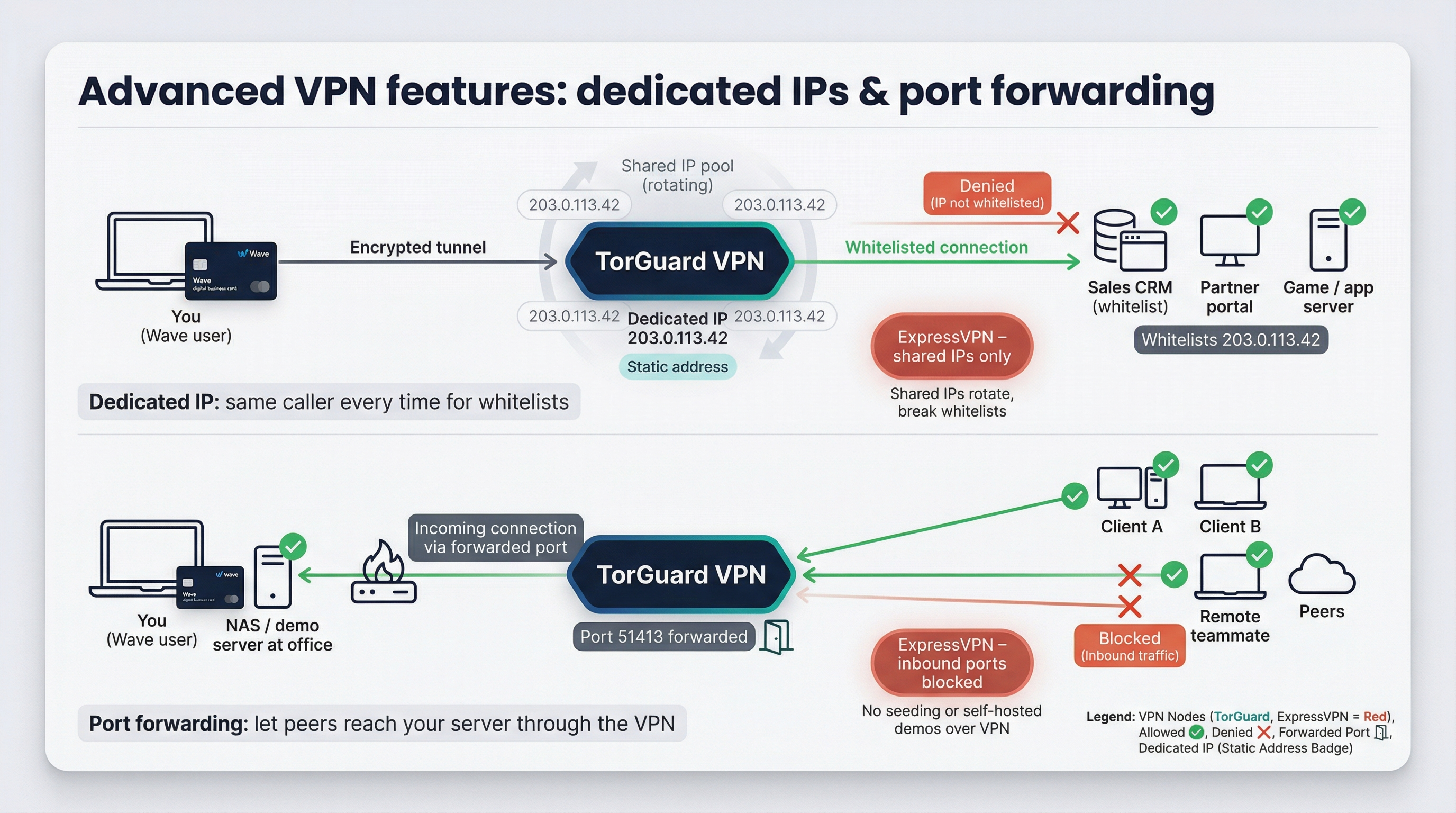
Dedicated IPs: staying consistent and whitelisting made simple
Sometimes one fixed address beats a pool of rotating ones. Picture a sales dashboard or lightweight CRM that trusts only pre-approved IPs. With a shared pool you connect from a new address each session, break the whitelist, and lock yourself out just before a meeting.
The TorGuard VPN service bundles a free dedicated IP and unlimited speeds in its Pro plan, while Standard subscribers can purchase the add-on. Choose a country, receive an address that only your account uses, and keep it as long as you stay subscribed. Teams that self-host a demo server or need to bypass captchas value that stability.
ExpressVPN takes the opposite view. Every exit node is shared to maximise anonymity, and the company does not sell static addresses. That protects privacy but fails IP-based whitelists.
If your workflow relies on the same caller every time, like an email API, a partner portal, or a gaming server, TorGuard supplies the steady identity you need. ExpressVPN cannot.
Port forwarding: opening doors when you need them
Some tasks require an incoming connection. You might seed large project files over BitTorrent, share a lightweight Node demo, or remote into a NAS at the office. To do any of that through a VPN you need a port mapped straight to your device.
TorGuard makes this simple. Reserve a port in the dashboard, add the number to your app, and traffic flows without extra work.
ExpressVPN blocks all inbound ports for safety. That choice stops unsolicited traffic but also prevents seeding and self-hosting. If your side project depends on peers reaching you, ExpressVPN pushes you toward workarounds like reverse proxies or dropping the VPN.
In practice, creatives who distribute big media libraries or developers who expose test environments lean on TorGuard’s forwarding. Everyone else enjoys ExpressVPN’s locked-down approach without thinking about ports.
Streaming and geo-unblocking
After a long expo day you crash in the hotel, open Netflix, and hit an error screen. If a VPN cannot dodge regional blocks, movie night turns into tech support.
ExpressVPN sidesteps that pain. Connect to any standard server, pay nothing extra, and the big platforms load as if you never left home. In a November 2025 check it unlocked all six services we tried (Netflix, Disney Plus, BBC iPlayer, Hulu, Max, Prime Video).
TorGuard takes a different path. On the base plan most entertainment sites detect the shared IP pool and shut the door. You must add a streaming or residential IP, wait for provisioning, then remember to switch locations when you travel. It works but feels like paying baggage fees on every flight.
For business travellers and weekend binge-watchers, convenience wins. ExpressVPN keeps movie night simple, one less hassle on the road. TorGuard fits only if you already need a dedicated IP and do not mind extra steps.
Ease of use and app experience
A VPN should stay invisible, not steal attention. ExpressVPN succeeds here. Open the app and you see one Connect button plus a smart location suggestion. Tap, wait a second, and you are protected. The layout looks the same on iOS, Android, macOS, and Windows, so muscle memory travels with you.

ExpressVPN simple connect app interface screenshot for ease of use.
After you connect, the app shows shortcuts; add Wave or your CRM and launch work in one tap. Need a quick break? Pause VPN for five minutes and it resumes automatically when you return. No extra steps.
TorGuard feels more like a networking toolbox. The main window lists protocol, cipher, port, and multiple drop-downs. Power users cheer, but newcomers hesitate. Once configured it runs reliably, yet changing servers or protocols means several menu clicks. The Android app is simpler, though still busier than ExpressVPN’s clean mobile screen.
Bottom line: if you want instant, friction-free protection, ExpressVPN wins. TorGuard rewards tinkerers, while most users risk losing minutes and focus when they only need to connect.
Customer support and reliability
Issues always surface at the worst moment, right before a demo or halfway through a virtual coffee. When they do, quick human help beats any FAQ search.
ExpressVPN staffs live chat 24/7. At 2 am on a Sunday we asked why Lightway failed to auto-connect on hotel Wi-Fi and received a clear fix in under three minutes. The agent also emailed a transcript for reference.
TorGuard relies on tickets first and live chat second. Our port-forwarding question waited six hours before a reply reached the inbox. That delay is fine if you plan ahead, but stressful when a trade-show network blocks your VPN mid-pitch.
Update cadence echoes those results. ExpressVPN refreshes the app almost monthly, adding servers and patching quirks without fuss. TorGuard’s desktop client can go several months between releases, which lets minor bugs linger.
Bottom line: ExpressVPN feels like having IT on speed dial. TorGuard’s help is capable once it arrives, yet slower replies and fewer updates make it a less dependable safety net.
Pricing and value for money
ExpressVPN keeps pricing simple. One plan, three term lengths, everything included. Pay month to month at $12.95, choose six months at $9.99 per month, or take the annual bundle for $99.95 and receive three extra months free, which averages about $6.67 per month. All tiers include the full feature set and a 30-day refund, so you can test the service for a full billing cycle with no risk.
TorGuard costs less up front but adds decisions. The Standard tier is $9.99 for one month or $59.99 for a year (about $5.00 per month) and drops to $3.88 per month on a three-year plan. Streaming or a dedicated IP moves you to the Pro tier at $12.99 monthly or $79.99 annually. A Premium plan lifts the device cap to 30 for teams and is priced higher. Refunds run only seven days, so you must catch speed or setup issues quickly.
How does that feel in practice? If you never watch Netflix and want the lowest long-term rate, TorGuard wins. Once you add a streaming IP or prefer flexible monthly billing, ExpressVPN lands within a dollar or two while delivering faster speeds, verified audits, and round-the-clock chat.
In short, TorGuard is the budget pick for tinkerers with a multi-year horizon. Everyone else gains convenience that outweighs the small premium ExpressVPN charges.
Conclusion
ExpressVPN delivers faster speeds, simpler apps, automatic streaming access, and 24/7 chat support—advantages that keep networking smooth when seconds count. TorGuard wins on specialised extras such as dedicated IPs, port forwarding, and lower long-term cost. If you value out-of-the-box convenience and minimal setup, choose ExpressVPN. If you need a static IP or plan to run niche services through the tunnel, TorGuard is the better fit.
🔥 Limited Time Deal
NewGet lifetime access to Postunreel with a one-time payment. Never pay again!
Your Go-To Solution for Stunning Carousels using AI!
Postunreel is a free AI carousel generator tool that helps you design captivating carousel posts for LinkedIn, Instagram, and other platforms. It makes it easier to increase social media engagement and grow your audience.
Create Free Carousel Now 🚀Related Blogs
The Modern Business Survival Guide: Preparing for the Problems You Can Not Predict
Learn how to build business resilience with practical strategies for managing unexpected problems, protecting communication, diversifying revenue, and preparing your team for disruptions.
How to Change Instagram Story Background Color
See how to change Instagram story background color on iPhone and Android. Try 4 easy, free methods: solid fills, gradients and color tints.
How Big Is 4x6 Photo? Size in Inches, CM & Pixels
How Big Is 4x6 Photo inches (10.16 x 15.24 cm), or 1200 x 1800 pixels at 300 DPI. Get size chart, crop tips and a simple 5 step print guide.