What Is a Digital Signature? (2026 Guide)
What is a digital signature and how does it protect your documents? I break down the tech, law, and how to use one no jargon, just answers.
Most explanations of digital signatures sound like they were written by a cryptography professor who forgot humans exist.
So let's fix that.
By the end of this guide, you'll know exactly what a digital signature is, how it works under the hood, and why it matters — even if you've never touched a line of code in your life.
Let's get into it.
What Is a Digital Signature?
Here's the simple version.
A digital signature is a mathematical technique that proves two things: the document you're looking at actually came from who it says it came from, and nobody touched it after it was signed.
Think of it like a wax seal on an old royal letter — except instead of wax, you're using public-key cryptography.
It's not the same as scribbling your name on a PDF (that's an electronic signature, and it's a much weaker cousin). A digital signature is cryptographically locked. Break the seal, and everyone knows.
You'll find these signatures behind the scenes in contracts, software updates, emails, and even cryptocurrency transactions.
How Do Digital Signatures Actually Work?
Okay, here's where it gets interesting.
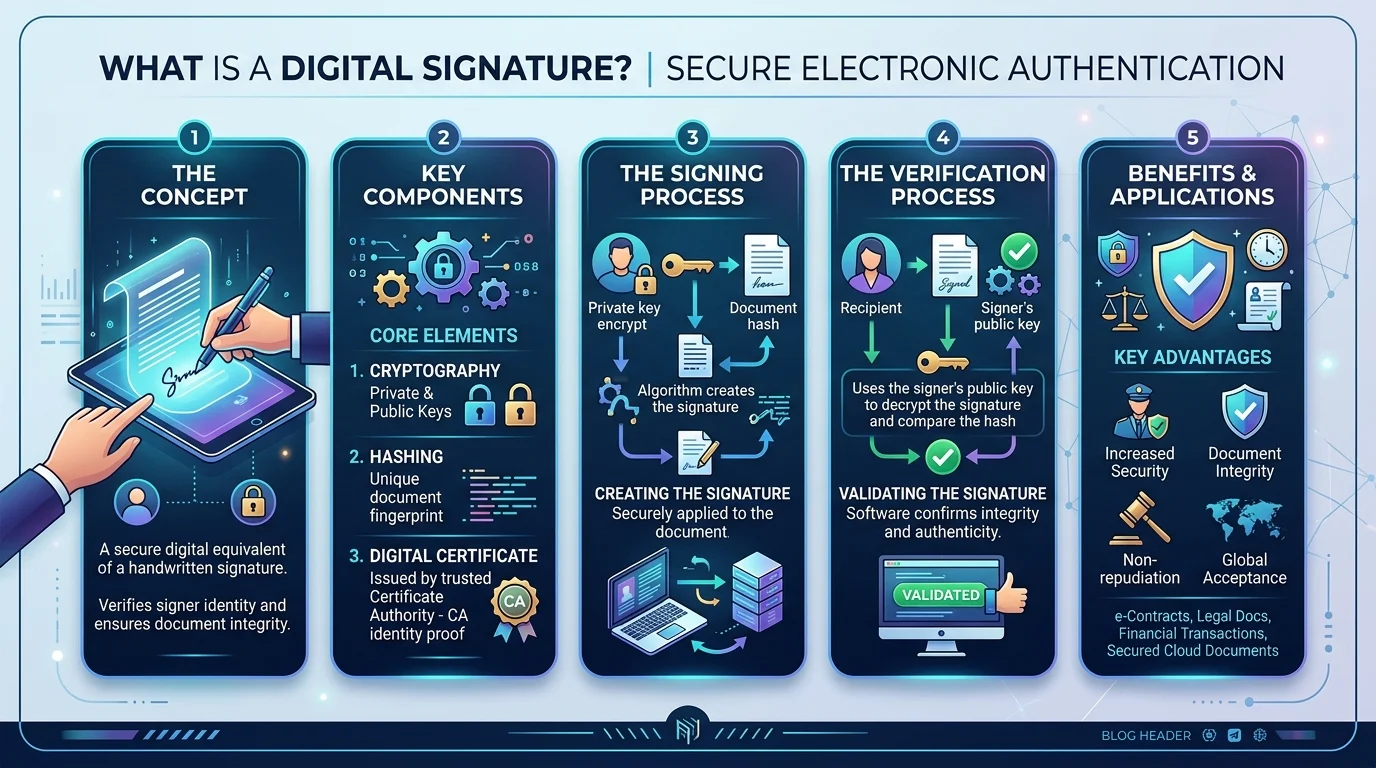
Every digital signature relies on two keys: a private key (only you have this) and a public key (anyone can have this). Together, they form what's called a key pair.
Here's the step-by-step version of what happens when you sign something:
Your document gets run through a hash function, which spits out a unique fingerprint of the file — this is your hash value.
That hash gets encrypted using your private key. Boom — that's your signature.
Whoever receives the document decrypts the signature using your public key.
They also generate their own hash of the document and compare the two.
If the hashes match, the document is authentic and untouched. If they don't match? Someone messed with it.
That's it. No magic. Just math.
This process relies on something called public key infrastructure (PKI), which is basically the whole system of certificates, authorities, and trust that makes this work at scale.
The Algorithms Behind the Curtain
You don't need to memorize this part, but it's good to know the names.
The most common cryptographic signature algorithms are:
RSA — the OG, still widely used
DSA (Digital Signature Algorithm) — built for U.S. federal standards
ECDSA — smaller keys, same security, faster performance, which is why Bitcoin and Ethereum both lean on it
EdDSA — the newer, faster sibling of ECDSA
If you're building anything blockchain-related, ECDSA is probably already running in the background without you even noticing.
Digital Signature vs. Electronic Signature — What's the Real Difference?
I get this question a lot, so let's clear it up once and for all.
An electronic signature is broad. Typing your name into a signature box? That counts. Legally, in the U.S., it's protected under the ESIGN Act and UETA, which basically say electronic signatures carry the same legal weight as ink on paper.
A digital signature, though, is a specific type of electronic signature — one that's backed by actual cryptography, not just intent.
In the EU, things get even more structured. Under the eIDAS regulation, there are three tiers:
Signature Type | Legal Strength | Requires Certificate? |
|---|---|---|
Simple Electronic Signature | Lowest | No |
Advanced Electronic Signature | Medium | Sometimes |
Qualified Electronic Signature | Highest (equal to handwritten) | Yes |
If you're running a business that handles contracts across borders, this table matters more than you'd think.
Why Should You Actually Care About This?
Fair question.
Here's the honest answer: if you send contracts, invoices, or sensitive files online — and let's be real, who doesn't — you're already relying on some form of digital trust, whether you realize it or not.
Digital signatures give you three things you can't get from a regular signature:
Authenticity — you know exactly who sent it
Data integrity — you know it wasn't altered
Non-repudiation — the sender can't credibly deny signing it
That last one is huge in legal disputes. It's the difference between "he said, she said" and having actual cryptographic proof.
If your work involves handling client data, contracts, or anything remotely confidential, it's worth reading up on how professionals protect sensitive work data — digital signatures are just one piece of a much bigger security puzzle.
Where Are Digital Signatures Used?
You're probably interacting with digital signatures more than you realize. Here's where they show up:
Contracts and agreements — replacing pen-and-paper entirely
Software downloads — verifying the app you're installing hasn't been tampered with
Email security — confirming a message is really from who it claims to be
Blockchain transactions — every crypto transfer is signed
Government and compliance filings — tax documents, legal paperwork, healthcare records
Regulated industries especially — banking, healthcare, legal — lean hard on digital signatures because the stakes of a forged document are just too high.
If you're curious how this fits into broader online security practices, this cloud security assessment guide is a solid next read.
Are Digital Signatures Actually Secure?
Short answer: yes, extremely.
Longer answer: it depends on the algorithm and how well the private key is protected. If someone steals your private key, they can sign things as you — which is why key management matters just as much as the cryptography itself.
There's also a newer conversation happening around post-quantum cryptography. As quantum computers get more powerful, some of today's algorithms (like ECDSA) could theoretically become vulnerable down the road. Researchers are already testing quantum-resistant alternatives, so this space is worth keeping an eye on if you're thinking long-term.
FAQ: Quick Answers to Common Questions
Is a digital signature legally binding?
Yes, in most countries. In the U.S., it's covered under the ESIGN Act and UETA. In the EU, qualified electronic signatures carry the same legal weight as a handwritten one.
Can a digital signature be forged?
Not without access to the private key. That's the whole point — without it, forging a valid signature is computationally infeasible.
Is a digital signature the same as a digital certificate?
No. A digital certificate verifies who owns a public key. A digital signature is the actual cryptographic proof created using that key pair.
Do I need special software to create a digital signature?
Usually, yes — a certificate authority or a signing platform handles the heavy lifting so you don't have to touch the cryptography directly.
Final Thoughts
Digital signatures aren't just a "nice to have" anymore.
They're the quiet infrastructure holding together contracts, software, emails, and financial transactions across the internet.
You don't need to become a cryptography expert to use one. You just need to understand what's actually happening behind that little green checkmark — and now, you do.
About the Author

Nathan Cole
Nathan Cole is a SaaS writer and AI product reviewer at Postunreel with a sharp focus on evaluating AI-powered tools for content creators, marketers, and growing businesses. He holds a degree in Computer Science and brings over five years of experience writing about software products, productivity tools, and marketing technology. Nathan approaches every review with rigorous hands-on testing, clear comparison frameworks, and an honest perspective that cuts through marketing hype. His goal is to help Postunreel readers make smarter decisions about the tools they invest in so they can build better content workflows without wasting time or money.
🔥 Limited Time Deal
NewGet lifetime access to Postunreel with a one-time payment. Never pay again!
Your Go-To Solution for Stunning Carousels using AI!
Postunreel is a free AI carousel generator tool that helps you design captivating carousel posts for LinkedIn, Instagram, and other platforms. It makes it easier to increase social media engagement and grow your audience.
Create Free Carousel Now 🚀Related Blogs
Best Free Photo Editing Software in 2026
Find best free photo editing software in 2026. Compare Affinity, GIMP, darktable, Photopea and Paint.NET, with edit workflow for bloggers.
How to Improve Focus in Photos: 11 Fixes
Blurry photos? Learn how to improve focus in photos with 11 proven fixes, from autofocus modes to focus stacking. Get sharper shots.
Generate Custom Infographic Illustrations for Complex Ideas
Learn how to create AI infographic illustrations with Dreamina. Turn complex ideas into clear, engaging visuals for presentations, reports, and blogs.