Big Data Analytics Tools in 2026: Buyer's Guide
Big data analytics tools aren't a one-winner race. Here's 4-layer stack real teams use in 2026, a comparison table and cost breakdown.
Big data analytics tools are the platforms and frameworks that store, process, query, and analyze datasets too large or fast-moving for a single machine to handle. In 2026, the leading options include Apache Iceberg for storage, Apache Spark and Apache Flink for processing, Snowflake and Google BigQuery for warehousing, and Power BI and Tableau for visualization. The smartest teams don't pick one — they assemble four layers that work together.
Now here's something nobody tells you when you start googling big data analytics tools.
Most of the "Top 15" lists you'll find are lying to you. Not maliciously. They're just answering the wrong question.
They treat this like a shootout — one winner, fourteen losers. But that's not how modern data teams actually work. I've watched companies burn six figures picking the "best" tool, only to discover they needed four tools that talk to each other.
So let me show you what's really happening.
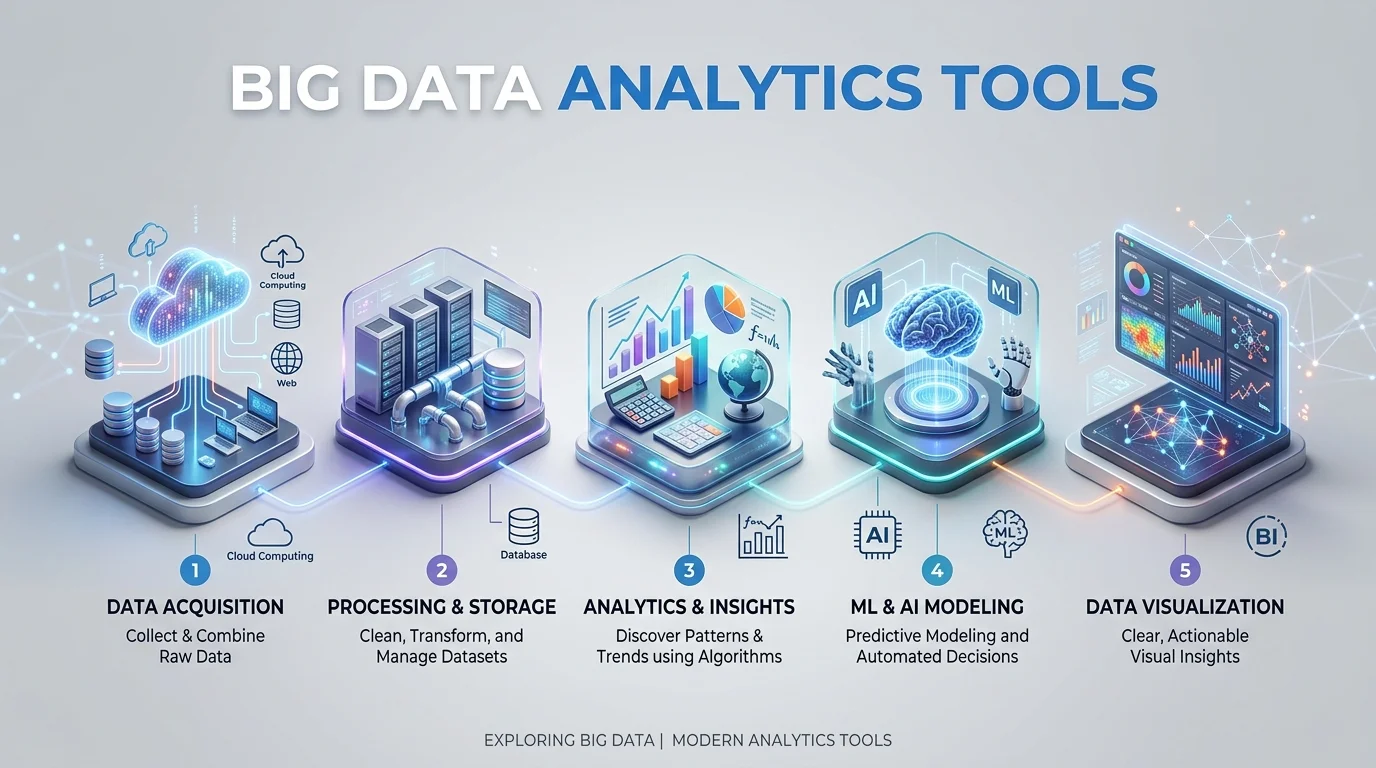
What Big Data Analytics Tools Are and Why the Definition Changed in 2026
Before we get into names and price tags, you need the mental model. Big data analytics tools are the platforms and frameworks built to store, process, query, and analyze datasets that are too large, too fast, or too messy for a single machine. They distribute the work across clusters so analysis stays possible at scale. Simple enough. But here's the part that shifted this year, and it changes how you should shop. As one 2026 category guide puts it, choosing tools now is less about finding a single best product and more about assembling the right layers for your data volume, velocity, and the questions you actually need answered.
That's the whole game. Layers.
You're not buying a tool. You're building a stack.
And once you see it that way, the paralysis disappears.
The Market Numbers That Should Motivate You
I'll be quick with the stats, because you've seen this genre before. But these three matter, and I want you to notice how much they disagree — that disagreement is itself useful information when you're building a business case. Vendors will quote you whichever figure flatters their pitch, so knowing the range protects you.
Statista forecasts global data volume hitting 182 zettabytes in 2025 and 394 zettabytes by 2028.
Fortune Business Insights values the big data analytics market at $394.70 billion in 2025, projected to reach $1,176.57 billion by 2034 at a 12.80% CAGR, with North America holding 36.40% share.
Market Research Future lands far more conservatively at $324.86 billion for 2025.
Same market. A $70 billion gap. Cite ranges, not single figures.
Layer One: Choosing Your Open Table Format and Storage Architecture
Most people skip this layer entirely, and it's the one that determines whether you're locked into a vendor for the next decade. Your open table format decides which engines can read your data, whether you get ACID transactions, and how painful your next migration will be. Get it right and everything above it becomes replaceable — swap your query engine on a Tuesday, nothing breaks. Get it wrong and you'll pay an exit tax for years. This is the decision I'd spend the most time on.
The good news: this fight is basically over.
Apache Iceberg won.
It's now the de facto standard, adopted by AWS, Google, Snowflake, Databricks, Dremio, and Cloudera. Netflix originally built it to fix Hive's directory-based table tracking, which couldn't guarantee ACID compliance and corrupted data during simultaneous reads and writes.
Iceberg gives you schema evolution, time travel queries, and hidden partitioning on top of Parquet, ORC, and Avro.
The Iceberg Trap Nobody Warns You About
Here's the contrarian bit, and it's the reason I'd tell you to budget differently than most guides suggest. Adopting an open table format without operational automation quietly reverses the benefit you adopted it for. Teams celebrate the migration, then watch query performance degrade over the following months and blame the engine.
A 2026 practitioner whitepaper puts it bluntly: metadata operations cancel out the adoption benefit if you skip compaction, expiration, orphan cleanup, and monitoring.
Translation? Budget for maintenance. Not just the migration.
Worth knowing about the alternatives: Delta Lake, Apache Hudi, Apache Paimon, and DuckLake all still have legitimate niches. Delta Lake in particular remains strong if you're deep in the Databricks ecosystem.
Worth noting too: newer approaches are emerging that query relational data directly without heavy pipeline engineering, which I covered in this Kumo AI relational foundation model review. It's a useful contrast to the traditional stack described here.
Layer Two: Choosing Your Big Data Processing Engine
I need to be direct with you here, because this is where teams waste the most money. Apache Spark built this industry and it's still excellent at what it's good at. But treating it as your universal hammer in 2026 is an expensive habit. The modern data stack has quietly unbundled Spark into specialized engines that each do one thing dramatically better and cheaper, and the analysis on ITNEXT says it cleanly: Spark remains best for heavy batch processing and large-scale distributed shuffles, but using it for Iceberg maintenance, interactive queries, or small-data analytics is expensive and slow.
So route your workloads instead.
Big Data Processing Engines Compared
Tool | Best For | Latency | Cost Profile | Learning Curve |
|---|---|---|---|---|
Apache Spark | Heavy batch ETL, large distributed shuffles, ML pipelines | Minutes (micro-batch) | High — cluster always running | Steep |
Apache Flink | True stream processing, event-driven apps | Sub-second (per-record) | Moderate — scales with stream volume | Steep |
Trino | Federated interactive SQL across sources | Seconds | Moderate — query-based | Moderate |
DuckDB | Single-node local analytics, notebooks | Milliseconds | Very low — no cluster | Easy |
ClickHouse | Real-time OLAP dashboards | Sub-second | Moderate | Moderate |
A 6-Step Guide to Routing Your Workloads
Follow this sequence when you're deciding what runs where. It takes about an afternoon and it's the highest-ROI planning exercise on this page.
Step 1 — Identify the workload type. Batch ETL, streaming, interactive SQL, or local analysis? Be honest about actual volume, not projected volume.
Step 2 — For streaming, pick Apache Flink. It processes data as it arrives rather than waiting for a complete dataset, handles out-of-order events through event-time processing, and maintains state with exactly-once guarantees.
Step 3 — For interactive SQL, pick Trino. It queries data where it lives across multiple sources, minimizing movement.
Step 4 — For single-node work, pick DuckDB or Polars. No cluster required. Your analysts will thank you.
Step 5 — For real-time OLAP, pick ClickHouse or StarRocks.
Step 6 — Keep Spark for the heavy batch jobs. That's where it earns its keep.
Every one of these reads the same Iceberg tables through the same catalog. That's multi-engine architecture working as designed.
Layer Three: Cloud Data Warehouse and Query Platforms
This is the layer most executives picture when they say "analytics platform," and it's where cloud-native analytics delivers its most obvious win — you stop managing servers entirely. The architectural principle doing the heavy lifting is separation of storage and compute, which means you can scale query power without touching your data footprint, and pay for each independently. Both major players implement it well, so this decision is lower-stakes than it feels.
Google BigQuery automatically scales the compute needed to execute queries, so analysts handle huge volumes without touching infrastructure.
Snowflake separates storage from compute, meaning heavy analysis doesn't degrade data availability.
Databricks and Amazon Redshift round out the serious contenders.
Honestly? For most mid-market teams, any of these four will work. Pick based on which cloud you're already in.
Open Source vs. Commercial: What You'll Actually Pay
This is the section most tool roundups skip, and it's usually the first question your finance team asks. The short version: open source shifts cost from licensing to headcount, and commercial platforms do the reverse. Neither is cheaper in absolute terms — they're cheaper for different team shapes.
Open source (Spark, Flink, Trino, DuckDB, ClickHouse, Iceberg) has no licence fee. But you're paying in engineering time for cluster ops, tuning, and the maintenance tax I mentioned earlier. Realistic if you have at least one dedicated data engineer.
Commercial and managed (Snowflake, Databricks, BigQuery, Power BI, Tableau) charges by consumption or seat. You trade dollars for not hiring. Usually correct below ~10 engineers.
Hybrid is where most 2026 teams land: open formats and open engines, running on managed infrastructure.
If hiring in-house isn't realistic yet, outsourcing is a legitimate path — my guide on how to choose a machine learning partner walks through vetting criteria that apply just as well to data engineering vendors.
Layer Four: Business Intelligence Tools and the Agentic AI Shift
Here's the layer where 2026 genuinely broke from the past, and if you take one strategic insight from this article, make it this one. Business intelligence tools used to compete on dashboard quality — better charts, more interactivity, less IT dependence. That era is over. Now they compete on whether an AI agent can query your data without hallucinating an answer, which is a completely different engineering problem. Gartner's 2026 Magic Quadrant, published 29 June 2026, frames the entire market as moving toward agentic AI, governed semantics, and AI-augmented decision support.
Who's leading?
Microsoft landed a Leader spot for the nineteenth consecutive year on the strength of Power BI and Microsoft Fabric, with 35 million-plus monthly active users. Qlik made Leader for its 16th straight year. Salesforce's Tableau and ThoughtSpot also placed as Leaders.
Why the Semantic Layer Is Your Insurance Policy
Don't skip this part, because it's the difference between AI that helps and AI that confidently invents your Q3 revenue. A semantic layer is the governed definition of what your metrics actually mean — one place where "active customer" or "net revenue" is defined, which every dashboard and every agent must reference.
Google Cloud's framing is the sharpest I've read: in a world where hallucinated data and conflicting metrics can kill a business, a code-based semantic layer keeps agents grounded in verified enterprise truth.
Add data governance and a proper data catalog on top, and you've got a stack that survives contact with AI.
Frequently Asked Questions About Big Data Analytics Tools
Let me answer the questions I get asked most often, because they're the ones the tool vendors tend to dodge. These are short on purpose — if you want depth, the sections above cover each in detail.
What is the difference between Apache Spark and Apache Flink?
Spark processes data in micro-batches, making it ideal for large-scale batch ETL and machine learning pipelines. Flink uses true per-record streaming with sub-second latency and event-time processing, making it the better choice for real-time applications. Most mature teams run both.
Are there free big data analytics tools?
Yes. Apache Spark, Flink, Trino, DuckDB, ClickHouse, and Apache Iceberg are all free and open source. The cost isn't licensing — it's the engineering time to operate them.
Which big data analytics tool is best for a small team?
DuckDB paired with dbt handles more than most small teams expect, often without any cluster at all. If you need a managed warehouse, BigQuery's serverless model means no infrastructure to babysit.
Do I still need Hadoop in 2026?
Rarely for new builds. Many enterprises still run Apache Hadoop for existing data lakes, but new architectures typically use object storage with Iceberg and a purpose-built query engine instead.
What skills do I need to work with these tools?
SQL first, then Python. If you work with Microsoft databases, SQL Server Management Studio (SSMS) is a free place to practice T-SQL and browse your data. Add familiarity with one cloud platform and a working understanding of data governance concepts. That combination covers the vast majority of roles.
What is a data lakehouse?
A data lakehouse architecture combines the low-cost open storage of a data lake with the reliability and transaction guarantees of a data warehouse. Apache Iceberg is the layer that makes it possible.
My Honest Recommendation
You don't need every tool on this page. You need four decisions made deliberately, and you can make all four this quarter.
Start with Apache Iceberg as your table format — it's the choice that keeps every future option open. Add Trino or DuckDB for querying before you reach for a cluster. Layer Power BI or Tableau on top, since both are safe, supported, and battle-tested by millions of users. Then invest in your semantic layer before you invest in anything flashy.
And resist over-engineering. The 2026 guidance is to invest in your query and communication layers, not your infrastructure sprawl.
Start there.
You'll be ahead of most teams twice your size.
Read Also: What Is an IT Managed Service Provider? 2026 Guide
About the Author

Nathan Cole
Nathan Cole is a SaaS writer and AI product reviewer at Postunreel with a sharp focus on evaluating AI-powered tools for content creators, marketers, and growing businesses. He holds a degree in Computer Science and brings over five years of experience writing about software products, productivity tools, and marketing technology. Nathan approaches every review with rigorous hands-on testing, clear comparison frameworks, and an honest perspective that cuts through marketing hype. His goal is to help Postunreel readers make smarter decisions about the tools they invest in so they can build better content workflows without wasting time or money.
🔥 Limited Time Deal
NewGet lifetime access to Postunreel with a one-time payment. Never pay again!
Your Go-To Solution for Stunning Carousels using AI!
Postunreel is a free AI carousel generator tool that helps you design captivating carousel posts for LinkedIn, Instagram, and other platforms. It makes it easier to increase social media engagement and grow your audience.
Create Free Carousel Now 🚀Related Blogs
URL Encoder and Decoder SpellMistake: Fix Broken Links and Encoding Errors (2026 Guide)
Learn how a URL encoder and decoder fixes broken links, %20 errors and double encoding. Follow the step by step guide, then try SpellMistake today.
SQL Server Management Studio (SSMS): The 2026 Guide
Learn what SQL Server Management Studio is, what's new in SSMS 22, and how to install it step by step. Free download, system requirements, and FAQs.
GBP/JPY Forecast: What Recent Yen Gains Mean for the Market
Explore the latest GBP/JPY forecast as yen strength, Bank of Japan policy expectations, UK economic conditions, interest rates, and global market confidence shape the currency pair’s outlook.