How To Use Social Media For E-Commerce 2026 Guide
Learn how to use social media for e-commerce in 2026 with a step-by-step guide covering UGC, influencers, live shopping & more.
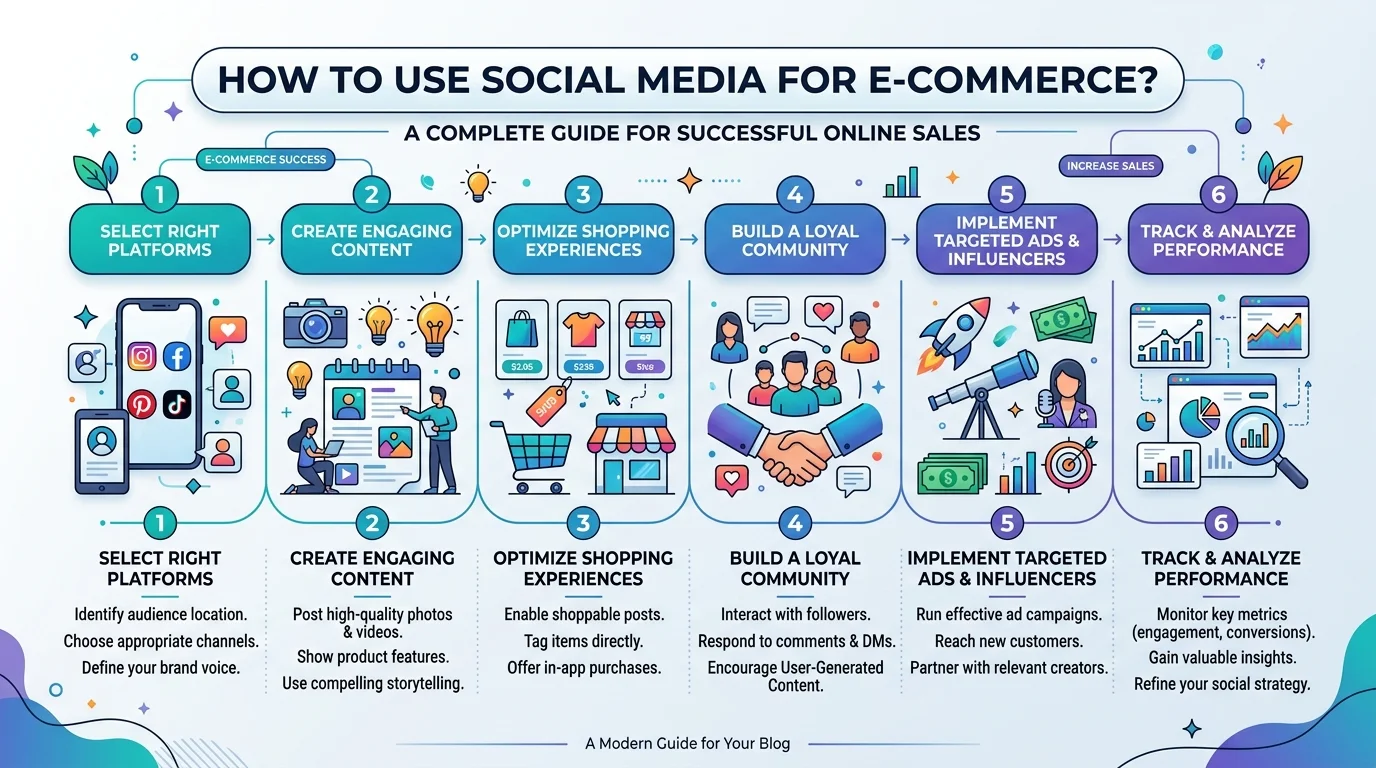
To use social media for e-commerce effectively, you need to connect native shopping tools (like Instagram Shopping and TikTok Shop) to your product catalog, build a steady stream of user-generated content (UGC), partner with micro-influencers, experiment with live shopping, layer in paid social ads, and remove friction with visible trust signals like free shipping and clear return policies. Below, I'll walk you through exactly how to do each one.
Hey, it's me — and today I want to walk you through something that completely changed how I think about selling online.
Here's the thing: social commerce isn't a trend anymore. It's the main event.
I've spent weeks digging through 2026 data, testing platform tools, and honestly? What I found surprised even me. So let's get into it.
Why Social Media Actually Matters For E-Commerce (Statistics You Should Know)
You've probably heard "social media is important for business" a thousand times. But let me be specific here, because vague advice helps nobody.
The truth is, shopping behavior has fundamentally shifted. According to Sprout Social, social commerce accounted for roughly 17% of total online sales in 2025, and Facebook has become the #1 platform for product discovery thanks to its massive user base.
And per Web Tonic's 2026 benchmark report, TikTok Shop leads platform conversion at 3.8%, followed by Instagram Shopping at 2.1%, and Pinterest Rich Pins at 1.9%.
Wild, right? That's a real, measurable gap between platforms — and it matters for where you focus first. If you want the broader playbook on standing out in crowded feeds, my post on viral marketing techniques for e-commerce brands on social media digs deeper into that side of things.
The Discovery-To-Purchase Gap Has Basically Disappeared
It used to be: see an ad → visit a website → maybe buy later.
Now? See a video → tap → buy. Done.
Insense's 2026 guide breaks this down well — platforms now connect product catalogs directly to shoppable surfaces like Meta Shops, Instagram Shopping, and TikTok Shop, so literally every post becomes a storefront.
Step 1: Set Up Native Shopping Tools On Every Platform
This is where most people get lazy — it's tedious setup work. But skipping it is like opening a store and locking the front door.
You need to connect your product catalog to:
Instagram Shopping
Facebook Shops
TikTok Shop
Pinterest Product Pins
YouTube Shopping
Here's how the platforms actually compare, based on Web Tonic and ShortsIntel's 2026 data:
Platform | Reported Conversion Rate | Best Fit For |
|---|---|---|
TikTok Shop | 3.8% | Impulse buys, viral discovery |
Instagram Shopping | 2.1% (highest AOV) | Fashion, lifestyle brands |
Pinterest Rich Pins | 1.9% (highest shopping intent/session) | Home decor, weddings |
Facebook Marketplace/Shops | Leads in transaction volume | Broad, older demographics |
Once your catalog is live, every single post — even a random Reel — becomes a potential sales page. That's huge.
Quick gut-check: If someone falls in love with your product in a video right now, can they buy it in three taps or less? If not, fix that before anything else.
Step 2: Build A UGC Engine (This Is The Part People Skip)
User-generated content (UGC) is probably the single most underrated lever in social commerce today. Why? Because people trust people, not brands.
Per SellersCommerce, 31% of shoppers say they're influenced by content shared by other users, and 49% rely specifically on reviews that include images.
And per Web Tonic, UGC on product pages drives 354% higher conversion rates compared to pages with no reviews at all, with photo reviews converting 2.6x better than text-only ones.
So how do you actually build this?
Ask for it. Send post-purchase emails requesting photos or reviews.
Incentivize it. Run branded hashtag campaigns with small prizes.
Seed products. Send free product to real customers or micro-creators in exchange for honest content.
Showcase it everywhere. Website, product pages, ads — not just your feed.
Step 3: Partner With Micro-Influencers, Not Celebrities
Here's something that might surprise you: bigger isn't always better.
Per JoinBrands, brands are now partnering with micro-influencers ten times more than mega-influencers, and smaller creators deliver 20% higher conversion rates. On TikTok specifically, nano-influencers achieve 10.3% engagement, while mega-influencers "rarely break 2%."
Think about it this way: a recommendation from a micro-creator feels like a friend texting you about a product. A celebrity endorsement feels like an ad.
My honest take: I'd rather work with ten micro-creators who genuinely love a product than one celebrity who's never used it.
Step 4: Try Live Shopping (Seriously, Just Try It)
I know livestreaming sounds intimidating. But hear me out.
Per Picmim's 2026 guide, live shopping conversion rates can hit 30% — roughly ten times the conversion rate of a standard e-commerce website.
Here's a dead-simple starting formula:
A phone
Decent lighting
A table of products
An engaging host (this can just be you!)
Start with one weekly 30-minute session. Show products, answer questions live, offer a small discount to viewers, and track what sells fastest. Then refine.
Step 5: Layer In Paid Social (Smartly)
Organic content builds trust. Paid social ads scale it.
Per Web Tonic, Meta captures 25–30% of e-commerce ad budgets, split between prospecting (broad/lookalike audiences) and retargeting ads (dynamic product ads/Advantage+ catalog). Meanwhile, TikTok's ad share has grown from roughly 3% in 2023 to 8–12% in 2026, driven by TikTok Shop's integrated checkout.
Treat these platforms as direct-response sales channels — not just brand-awareness tools — and measure them accordingly.
Step 6: Make Trust Impossible To Ignore
Per SellersCommerce:
58% of shoppers feel confident buying when free delivery/returns are offered
50% are influenced by fast delivery
49% rely on reviews with images
46% care about secure payment options
45% feel more confident with clear return policies
Practically speaking: mention free shipping in captions and product pages, show real reviews with photos, and make your return policy visible, not buried. Small friction points kill sales.
How To Measure If Your Social Commerce Strategy Is Working
Don't skip this. Setting things up is only half the job — tracking results is what tells you whether to double down or pivot.
Track these core metrics:
Click-through rate (CTR) on shoppable posts vs. standard posts
Conversion rate by platform (compare against the benchmarks in the table above)
UGC-driven conversion lift — track sales from posts featuring customer content vs. brand-only content
Return on ad spend (ROAS) for paid social campaigns, segmented by prospecting vs. retargeting
Average order value (AOV) by platform — Instagram tends to skew higher, per ShortsIntel
If you're looking to tighten up the numbers side of this even further, my guide on e-commerce conversion optimization tips covers practical fixes for turning more of that social traffic into actual sales.
Frequently Asked Questions
What is social commerce?
Social commerce refers to buying and selling products directly within social media platforms, using tools like shoppable posts, in-app checkout, and live shopping — rather than redirecting users to an external website.
Which social media platform converts best for e-commerce?
Based on 2026 data, TikTok Shop leads platform conversion at 3.8%, followed by Instagram Shopping at 2.1%, though Instagram often wins on average order value and Facebook leads in raw transaction volume.
Are micro-influencers really better than celebrities for e-commerce?
Often, yes. Micro- and nano-influencers tend to post higher engagement rates and stronger conversion-per-dollar compared to mega-influencers, largely because their recommendations feel more personal and trustworthy.
Is live shopping worth trying for a small brand?
Yes — you don't need a studio. A phone, good lighting, and a weekly 30-minute session are enough to start, and live shopping conversion rates can far exceed standard website conversion rates.
What's the biggest mistake brands make in social commerce?
Treating it purely as a branding channel instead of a direct sales channel — and skipping the setup of native shopping tools that let people buy without leaving the app.
Key Takeaways
Social commerce is a measurable revenue channel, not just a branding play — treat it that way.
Connect your catalog to Instagram Shopping, TikTok Shop, Facebook Shops, Pinterest Product Pins, and YouTube Shopping.
UGC and photo reviews significantly outperform brand-only content on conversion.
Micro-influencers consistently outperform celebrities on engagement and ROI.
Live shopping can convert at rates far above a standard website.
Trust signals — free shipping, secure payment, visible return policy — directly affect purchase confidence.
Track CTR, conversion rate by platform, UGC lift, ROAS, and AOV to know what's actually working.
About the Author

Claire Ashton
Claire Ashton is a social media marketing writer and content strategist at Postunreel, where she covers platform trends, content planning frameworks, and data-backed strategies for growing an audience on LinkedIn, Instagram, and beyond. She has spent over six years working in social media marketing across agencies and in-house teams, giving her a well-rounded understanding of what works for both large brands and solo creators. Claire stays ahead of platform algorithm changes, studies engagement data closely, and writes guides that help Postunreel readers build consistent, high-performing content strategies without needing a full marketing team behind them.
🔥 Limited Time Deal
NewGet lifetime access to Postunreel with a one-time payment. Never pay again!
Your Go-To Solution for Stunning Carousels using AI!
Postunreel is a free AI carousel generator tool that helps you design captivating carousel posts for LinkedIn, Instagram, and other platforms. It makes it easier to increase social media engagement and grow your audience.
Create Free Carousel Now 🚀Related Blogs
Internet Options by Address: How to Find the Best Provider at Your Door
Find internet options by address in 3 simple steps. Check fiber, cable and 5G providers, spot map errors, and pick the right plan for your home today.
How to Clear Cache in Chrome: Step by Step Guide
Learn how to clear cache in Chrome on desktop, Android and iPhone. Follow our simple steps, try a hard reload, and fix stale pages in under a minute.
URL Encoder and Decoder SpellMistake: Fix Broken Links and Encoding Errors (2026 Guide)
Learn how a URL encoder and decoder fixes broken links, %20 errors and double encoding. Follow the step by step guide, then try SpellMistake today.