Wan 2.7 Edit Video API: Integrating Programmatic Video Processing into Existing Editorial Pipelines
Streamline post-production using the Wan 2.7 Edit Video API. Integrate programmatic asset patching and version control into your editorial workflow via Kie.ai.
Wan 2.7 Edit Video API: Integrating Programmatic Video Processing into Existing Editorial Pipelines
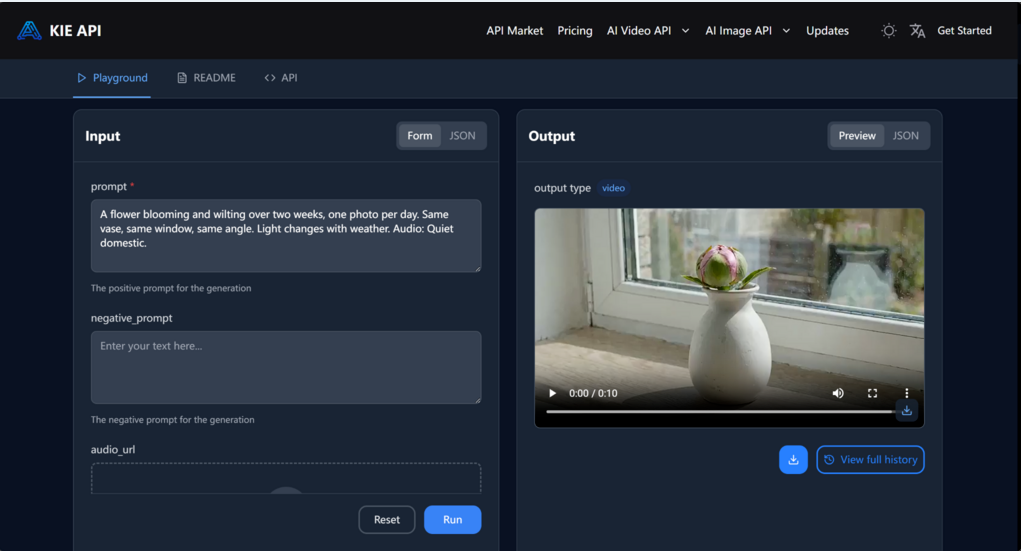
Modern post-production environments are increasingly reliant on automated workflows. For editorial teams and VFX houses, the challenge lies in maintaining high-quality output while managing the rapid iteration cycles required by current projects. The emergence of the Wan 2.7 Edit Video API offers a mechanism to handle visual revisions programmatically, moving beyond manual re-rendering processes.
The Role of Programmatic Editing in Editorial Workflows
Traditional editorial pipelines often face bottlenecks when visual changes are required late in the process. When a project enters the post-production stage, minor visual adjustments often mandate the re-rendering of entire sequences. This process is resource-intensive and often inefficient. By deeply integrating the Wan 2.7 Edit Video API into existing editorial pipelines, teams can implement targeted, instruction-based modifications.
Treating video assets as dynamic data that can be updated via API endpoints allows editorial teams to perform automated retouching and asset versioning. This approach fosters an agile production environment where changes are applied to specific elements, significantly reducing the computational load on local render farms and accelerating the delivery of final masters.
Technical Implementation and Architecture
The core functionality of the Wan 2.7 Edit Video API lies in its ability to receive precise, text-based commands to execute visual modifications. In a production context, this enables developers to write scripts that automate common editorial tasks, such as background color mapping adjustments, style transfers, or dynamic removal and masking of specific elements.
When integrated via a stable gateway like Kie.ai, these API calls can be queued as part of a larger asset management system. This architecture ensures that when a shot requires a revision, the system automatically triggers the API, applies the necessary patch, and returns the updated frame data to the review system, eliminating the need to manually restart the entire initial generation cycle.
Data communication and parameter mapping form the cornerstone of this functionality. When constructing pipeline scripts, the request payload of the API includes not only the source video data but also a complex set of instructions defining the scope and intensity of visual adjustments. Through a standardized JSON structure, engineers ensure parameter consistency across different shots, enabling reproducible results in a production environment.
Optimizing Production Efficiency and Cost Management
For VFX supervisors and studio managers, the viability of an API-driven workflow depends on cost predictability and pipeline stability. The Alibaba Wan 2.7 Video API provides a transparent pricing structure that allows for precise budget forecasting for generative tasks.
Accessing these services through Kie.ai provides a highly available environment for large-scale production requirements. The pricing supports high-concurrency professional needs: 720P resolution generation is priced at $0.08 per second, while 1080P resolution is approximately $0.12 per second. By utilizing Kie.ai top-up options, which include a 10 percent bonus, the effective cost can be further optimized to $0.072 per second for 720P and $0.108 per second for 1080P.
This cost transparency is essential for incorporating the Wan 2.7 Text-to-Video API, Wan 2.7 Image to Video API, and Wan 2.7 Reference To Video API into standard production budgets. By utilizing these tiered cost models, technical leads can allocate resources flexibly across different project phases—from pre-visualization to final asset delivery—thereby controlling expenses while ensuring project progress.
Expanding Applications for Multimodal API Suites
The Wan series offers a comprehensive range of capabilities that extend far beyond basic text-to-video generation. In a production pipeline, the utility of these APIs is cumulative.
The Wan 2.7 Image to Video API allows for the conversion of static storyboards into motion sequences, bridging the gap between concept art and editorial cuts. Simultaneously, the Wan 2.7 Reference To Video API addresses the critical issue of subject identity stability, using multiple reference inputs to ensure that characters remain consistent across different viewing angles and camera movements.
When these interfaces are combined with the Wan 2.7 AI Video Generator and the broader Wan AI API suite, they build a robust ecosystem for managing visual assets. Developers can build custom interfaces and plugins to inject these functions directly into existing Digital Content Creation (DCC) software, ensuring that editorial systems remain powerful yet lightweight.
Version Management Strategies in Automated Pipelines
A significant advantage of programmatic video processing is the introduction of granular version control logic. Utilizing the Edit Video API, studios can treat every visual revision as a patch operation. In version management systems, this manifests as differential tracking of video assets.
Engineers can design scripts that, upon receiving updated assets from the API, automatically compare visual differences between versions and record these operations in the change logs of project management software like ShotGrid. This non-destructive editing approach protects the integrity of the original source assets while ensuring that the team can rapidly roll back to the last stable version if any generative error occurs.
Scheduling and Fault Tolerance for Large-Scale Tasks
When handling large-scale generation tasks, API concurrency management and error recovery strategies become paramount. The API gateway provided by api7.ai supports asynchronous task scheduling, meaning pipelines can continue executing other non-blocking tasks without waiting for generation to complete.
Implementing retry logic in Python scripts is a necessary measure for system robustness. When an API request fails due to transient network fluctuations or server timeout, an built-in exponential backoff algorithm effectively prevents unnecessary pressure on the server while ensuring that the task eventually succeeds.
Furthermore, monitoring real-time indicators of generation quality and API status codes helps teams identify potential issues before production bottlenecks emerge. By logging these API statuses to centralized monitoring platforms, technical operations teams can obtain visual data regarding generation latency, request success rates, and bandwidth consumption.
Conclusion: The Position of Wan AI API in Professional Production
The integration of programmatic video processing into editorial workflows represents a vital evolution in production efficiency. As the Wan 2.7 Video API continues to mature, its core value in professional post-production pipelines will center on its capacity to automatically handle repetitive or highly complex visual tasks.
For teams managing complex editorial environments, the focus should be on utilizing these APIs as integrated nodes within an automated pipeline, rather than as standalone auxiliary tools. By focusing on building API-driven workflows, studios can maintain their established quality standards while achieving greater operational velocity and cost-efficiency in a highly competitive market.
🔥 Limited Time Deal
NewGet lifetime access to Postunreel with a one-time payment. Never pay again!
Your Go-To Solution for Stunning Carousels using AI!
Postunreel is a free AI carousel generator tool that helps you design captivating carousel posts for LinkedIn, Instagram, and other platforms. It makes it easier to increase social media engagement and grow your audience.
Create Free Carousel Now 🚀Related Blogs
Free Photo Editing App for iPhone: 7 Picks 2026
Snapseed is the best free photo editing app for iPhone in 2026. Compare 7 free editors, see which have no watermarks, and edit like a pro.
How to Resize an Image on iPhone (2026 Guide)
Resize an Image on iPhone in seconds. Free built in methods, exact pixel dimensions & platform sizes for Instagram, LinkedIn & more.
How to Exit Incognito Mode on iPhone (2026 Guide)
Learn how to exit incognito mode on iPhone in seconds step-by-step for Safari and Chrome, plus fixes for common private browsing glitches.